The Benefit of Exosomes as Disease Biomarkers
Extracellular vesicle markers (EVs), including exosomes, contain disease-specific markers from their cells of origin, enabling non-invasive detection of novel biomarkers in accessible biofluids. EVs, secreted by various cell types, can cross biological barriers, such as the blood-brain barrier, and carry a rich cargo of proteins, RNA, lipids, and DNA that reflect the physiological or pathological state of their cells of origin.
Exosome Biomarkers at Evotec
Our platform allows us to detect RNA and protein from the same sample. This can reveal correlations between RNA and protein expression to identify biomarker patterns invisible to traditional single-omics analysis.
From Plasma EVs:
From CSF (Cerebrospinal Fluid) EVs:
Evotec's Exosome Expertise
Evotec's proprietary EV isolation platform captures and enriches EVs with high fidelity, supporting the discovery of elusive biomarkers and opening new avenues for translational research. We offer tailored solutions, adapting our platform to specific research needs from exploratory biomarker discovery to clinical assay development.
Evotec's expertise in extracellular vesicle biomarkers is defined by the following capabilities:
- Isolating EVs with high fidelity:
- Differential ultracentrifugation (UC)
- Ultrafiltration (UF)
- Size exclusion chromatography (SEC)
- Characterizing EVs using ISEV standards:
- Measure concentration and size distribution
- Profile EV marker expression
- Assess composition and purity
- Analyzing EVs through Evotec's PanOmics platforms:
What Makes Evotec Different:
Unlike conventional EV isolation methods that require separate RNA and protein workflows, our integrated approach allows us to analyze RNA, miRNA, and protein contents from the same sample, reducing sample volume requirements and revealing novel biomarker signatures.
Evotec's Extracellular Vesicle Marker Workflow
Through our advanced technologies, we can isolate, enrich, and characterize EVs in a reproducible and scalable manner, facilitating the discovery of EV biomarker signatures that can inform diagnosis, prognosis, and therapeutic development.
Our Workflow (Figure 1):
- EV Purification & Quality Control
Differential ultracentrifugation (UC), ultrafiltration (UF), or size exclusion chromatography (SEC) is adapted to the sample type and research goals. - Platform Selection & Analysis
Simultaneous multi-omics integration through Evotec's PanOmics platform. - Data Analysis & Reporting
PanHunter bioinformatics platform processes multi-layer data to identify EV biomarker signatures.
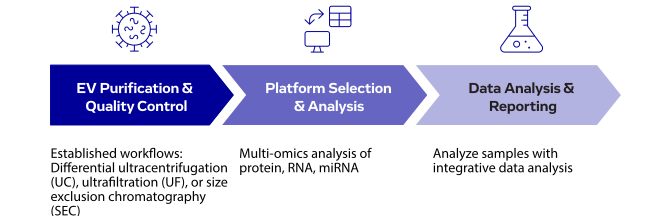
Figure 1. Evotec’s EV biomarker workflow.
We applied size exclusion chromatography enrichment and compared detection sensitivity to neat plasma samples.
As shown in Figure 2, two independent biomarker proteins showed significantly elevated detection in EV isolations versus neat CSF and plasma, enabling identification of disease signatures previously undetectable in unenriched samples.
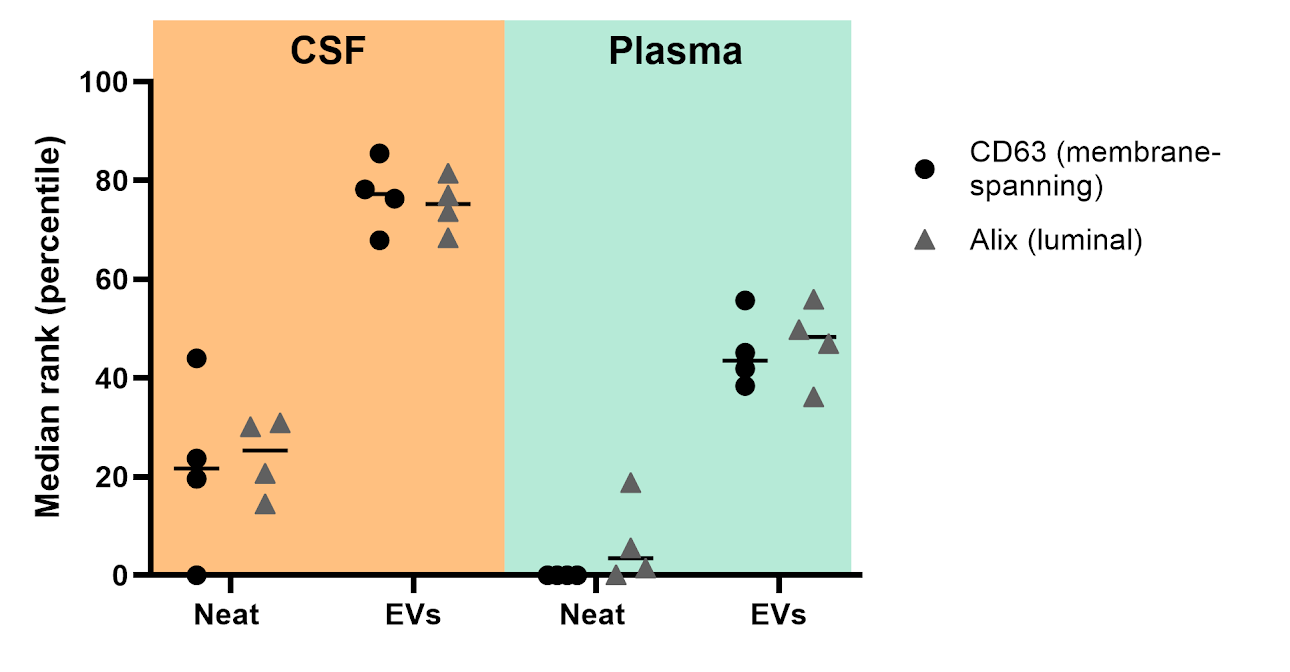
Figure 2. Two independent proteins with manyfold elevated detection in EV isolations compared to neat CSF and plasma.
Collaborate With Our Exosome Biomarker Experts
Extracellular vesicle markers, including exosomes, can be leveraged as a non-invasive method of gaining disease insights from their cellular source.
Evotec’s scalable and quality-controlled workflow for the enrichment and analysis of EVs can detect unique biomarkers and is tailored to your project needs.
Frequently Asked Questions
Can EVs be isolated from all extracellular fluid types?
Yes, EVs can be isolated from all extracellular fluid types because virtually all cell types secrete EVs into fluids such as plasma, CSF, and tears.
Does Evotec offer multi-omics analysis?
At Evotec, we conduct multi-omics analysis of EVs using our in-house PanOmics platform, allowing unbiased analysis.
Does Evotec offer assay development?
Yes, Evotec is at the forefront of targeted assay development of identified biomarkers.
Can RNA and protein detection in EVs be combined to save on sample volume?
Yes, Evotec has established protocols that allow for the detection of RNA and protein from the same sample and performed downscaling experiments to allow EV proteomic analysis from small sample volumes, e.g., 600 µL CSF.
Do you have established workflows for high-throughput analysis of patient samples?
Yes, the EV platform is set up for high-throughput analysis of patient samples.