The Challenge
Biomarkers are a measurable feature of a normal pharmacological response to drugs or disease state and are critical in drug development to provide an understanding of the effects of a drug on the body. These can be measured and evaluated in biological matrices including blood and plasma. Previously, colorimetric assays have been utilized to analyze small molecule biomarkers, however, LC-MS is beginning to be used more frequently due to its high throughput capability and increased sensitivity and selectivity.
The challenges in bioanalysis of biomarkers include their endogenous nature which can compromise the accuracy and precision of an assay. Therefore, for a successful biomarker assay, this interference needs to be overcome. Additionally, the presence of closely related endogenous analogues or isomers may cause interference due to their structural similarity. Another limitation may be the dynamic range of the LC-MS for certain compounds depending on the natural variance and the degree of up/down regulation that may occur. Biomarker stability can also cause a problem as well as biomarker specific issues including, but not limited to, size and polarity. Solutions to some of these are outlined below.
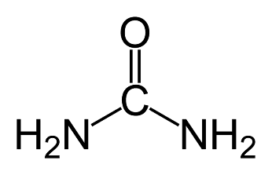
Urea Quantification
Quantification of urea in biological matrices using LC-MS/MS poses many challenges due to its low molecular weight, polar characteristics and endogenous nature in most species.
Urea is hydrophilic and therefore unretained on a standard reverse phase liquid chromatography (LC) system. It also cannot utilize ion pair reagents due to its lack of charge at usable pHs. HILIC chromatography provides good retention however, issues are encountered when using acetonitrile as the mobile phase for urea analysis. Acetonitrile greatly contributes to the background noise of the urea MRM causing interference with the urea quantification.
Finally, calibration lines and quality control samples cannot be prepared by spiking urea into blank matrix due to the endogenous levels, so an alternative is required.
The Solution
The successful LC method used a HILIC gradient but with methanol as the organic phase. While methanol is not typically used in HILIC chromatography, due to its inability to form an organic bilayer in the column, retention of urea was achieved.
Plasma samples were extracted using a protein precipitation method. To quantify urea a stable labelled version was used as a surrogate analyte and a different stable labelled-urea used as an internal standard (IS). The linear labelled urea calibration line was used to quantify native urea using peak area ratio. This approach was shown to be accurate for spiked urea QCs in plasma.
The Outcome
A quantitative method for urea was developed in mouse plasma, achieving an LLOQ of 2.50 ng/mL. Recovery was 87.9% and matrix effects were minimal at 103% in plasma compared to matrix free reference solution.
Creatinine
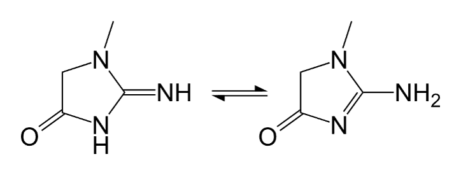
Creatinine is a key biomarker for renal health as its clearance from the body occurs at a constant rate. Analysis of this biomarker is challenging due to its endogenous nature and its analytical challenges. Creatinine is a very low molecular weight (113 Da), highly polar molecule which means that a standard reverse phase chromatography approach would not be applicable. The client requested that a semi quantitative LC-MS method was developed to compare peak areas between plasma samples from various groups of rats.
Our Solution
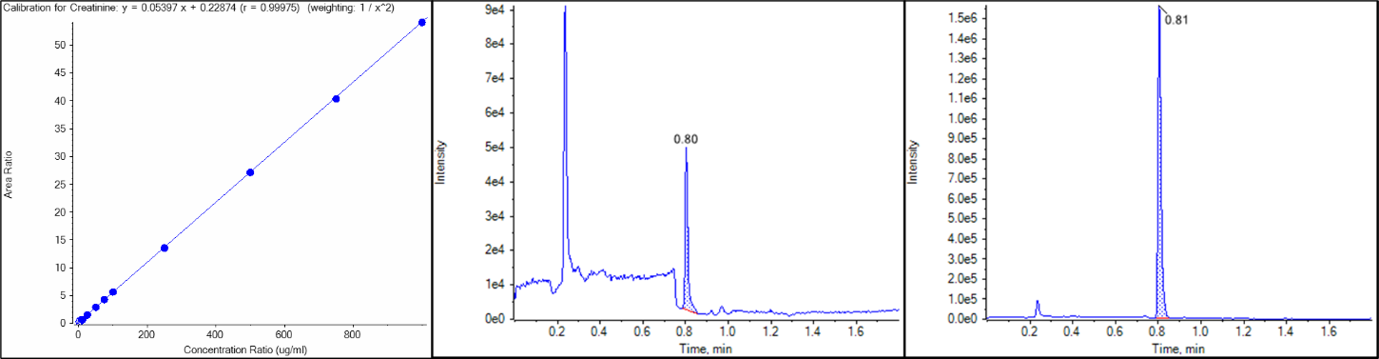
In this example, Cyprotex manually infused a solution of creatinine and its deuterated internal standard to generate a selective MRM for both the analyte and the internal standard. A robust HILIC LC method was developed in which creatinine was well retained and separated from other matrix components. To extract creatinine from plasma, protein precipitation was used. The supernatant was then diluted further and analyzed by LCMS.
The Outcome
A semi-quantitative LC-MS method for analysis of creatinine in rat plasma was developed with a LLOQ of 7.50 µg/mL.
Example Calibration Line and Chromatograms