Introduction
Bispecific and multispecific antibodies are designed to simultaneously bind two or more distinct antigens or epitopes.1 This dual targeting can provide more efficacious therapies by precisely affecting multiple disease pathways concurrently or, in the case of T-cell engagers, enhancing the body’s ability to fight cancer by recruiting immune cells to tumor sites2.
The promise of bispecific and multispecific therapeutics is driving the biopharma industry’s investments in this sector. According to a recent report, these therapeutics have a projected revenue growth exceeding 26% between 2023 and 2028, which is approximately 5-fold higher than the growth rate for monospecific antibodies.3 However, the complex design and manufacturing of these molecules is challenging for biopharma companies4, and requires careful consideration when selecting a scalable process to ensure delivery of high levels of purity with high mass output and enable cost effective delivery of medicine to patients.
From a manufacturing perspective, bispecific and multispecific antibodies consist of 3 to 4 different polypeptide chains that require precise assembly within the cells used for expression – typically mammalian cells such as CHO – to create drug substance. Any misassembled or partial molecules are considered product-related impurities that must be removed from the manufactured drug substance lot. Additionally, even correctly assembled molecules may have reduced stability due to the molecule’s complexity, resulting in lower overall productivity. This can result in increased time, effort, and lower yields for process development, as well as increased complexity for analytical characterization.
At Just – Evotec Biologics, we have an established track record in addressing the challenges of bispecific and multispecific antibodies through a comprehensive and innovative manufacturing approach. This includes initially assessing molecule developability via AI/ML algorithms and applying molecular engineering mitigations when needed. Then, high-expressing CHO cell clones are generated using an optimized cell line development workflow, and evaluated using advanced and high-throughput analytics such as the Multi-Attribute Method (MAM) for improved upstream and downstream development. Finally, our unique intensified cell culture platform with its innovative perfusion process supports healthier cells by continuously supplying fresh nutrients, removing metabolic waste, and reducing product retention time in the bioreactor, thereby enhancing productivity and product quality. As an example of potential outcomes, we recently produced >6 kg of bispecific mass output from a single 500L, 15 day run. This type of output is exceptional in the industry and is enabled by our unique combination of technology and experience.
Molecular Design of Bispecific Antibodies
Molecular design plays a fundamental role in the developability and manufacturability of bispecific antibodies. Strategic selection and careful design of bispecific formats are critical to achieving the desired biological activity while enabling correct heavy and light chain pairing to minimize formation of mis paired species and other product-related impurities. At Just – Evotec Biologics we work with our clients to analyze their initial molecular design with advanced AI tools and support molecular optimization, helping improve expression, stability,
and overall manufacturability.
Our proprietary Abacus™ antibody analysis and engineering platform performs comprehensive in silico manufacturability assessments of bispecific antibodies. Using machine learning–based algorithms, the system identifies stability liabilities within variable domains and recommends sequence modifications to enhance conformational stability. In addition, the platform evaluates MHC-II binding potential to assess immunogenicity risk, predicts susceptibility to post-translational modifications, and analyzes surface properties related to solubility and aggregation.
We further perform empirical biophysical characterization to validate predicted stability issues, guide sequence optimization, and refine candidate selection. High-throughput screening assays rapidly evaluate key attributes such as expression levels, thermal and conformational stability, potential aggregation issues, solubility, and binding affinity. These empirical data provide critical insights into the manufacturability of each candidate, allowing for early optimization and selection of molecules with the most favorable profile, reducing Chemistry, Manufacturing, and Controls (CMC) development risk prior to embarking on clinical and commercial stage manufacturing.
This highly efficient, data-driven approach to bispecific and multispecific candidate selection can deliver candidates in extremely short timelines (sometimes as little as a week) to support effective transition into cell line and process development.
Optimizing Cell Line Development Workflows
Successful production of bispecific antibodies relies heavily on the development of stable, highly productive cell lines. This begins with strategic vector design – often involving multiple plasmids to independently express the necessary polypeptide chains. Optimizing the configuration and relative ratios of these plasmids during transfection is critical to achieving balanced chain expression, which promotes correct heavy and light chain pairing and minimizes misassembled or partial species. Robust host cell lines are also essential for this process. Following transfection, stable pools and clones are screened to identify those with optimal growth and productivity, low levels of product-related impurities, and consistent quality attributes. At Just – Evotec Biologics, we have developed and refined our expression systems specifically for bispecific antibody production. In one case study, a bispecific antibody – engineered using the knob-in hole format – was expressed using our proprietary J.CHO™ High Expression System. The J.CHO host cell line utilizes a glutamine synthetase (GS) knockout background. In this case, dual selection using GS and puromycin was performed to generate stable cell pools. High throughput 24-well plate fed-batch cultures of these pools demonstrated expression levels ranging from 1 to 3 g/L.
To further optimize expression and molecule assembly, we systematically varied the ratio of plasmids encoding the individual antibody chains (Figure 1) and evaluated different configurations for chain placement across plasmids (Figure 2). These strategies helped to balance chain ratios and allow correct chain assembly.
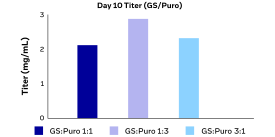
Figure 1: Bispecific antibody titer of transfectant pools transfected with three different ratios of plasmid.
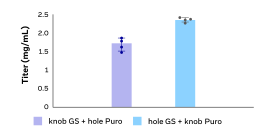
Figure 2: Bispecific antibody titer of transfectant pools with antibody chains on different plasmids.
Following recovery from selection, cells were cultured in a 24-well plate, 10-day fed-batch production assay, yielding high titers of approximately 3 g/L (Figure 3) with main peak purity exceeding 92% (Figure 4). These results demonstrate that we can achieve high productivity and correctly assembled molecules through our optimized expression platform.
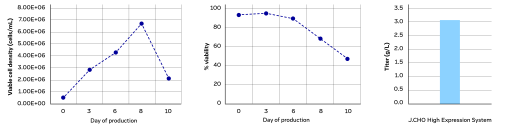
Figure 3: 10 day fed-batch cell culture of a GS KO CHO-K1 cell line expressing a bispecific antibody to 3 g/L.
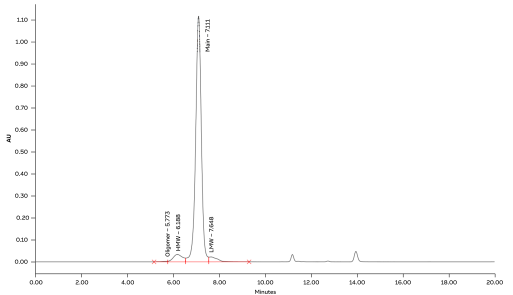
Figure 4: Size Exclusion Chromatography HPLC data showing purity of bispecific antibody expressed in a GS KO CHO-K1 cell line at
3 g/L.
Further, aiming to replace and simplify dual selection systems, we have established a highly efficient expression platform that allows the use of multiple vectors using only a single selection marker (glutamine synthetase). This streamlined approach enables the co-expression of up to four different antibody chains in the GS KO CHO-K1 host without the need for additional antibiotic resistance markers, simplifying vector design, and reducing regulatory complexity.
Just – Evotec Biologics inducible GS KO CHO-K1 host cell lines support expression of challenging antibody candidates. This system is particularly valuable for expressing molecules that are difficult to produce due to their complex structure or potential cytotoxicity (Figure 5). By enabling controlled expression, our inducible platform provides an additional layer of flexibility for advancing bispecific antibody programs through early development and into manufacturing.
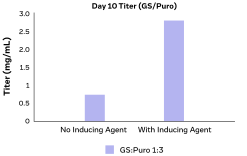
Figure 5: Bispecific Antibody Titers from Transfectant Pools Created with an Inducible Host Cell Line. Data shows antibody titer with and without inducing agent.
Advanced Analytical Strategies to Support Bispecific Antibody Development
Robust analytical methods are essential for supporting bispecific antibody development, particularly in monitoring product quality and ensuring correct molecular assembly. At Just – Evotec Biologics, high-throughput chromatographic and electrophoretic techniques play a critical role during early process development by helping identify chain mismatches, misassembled species, and product-related variants. Additionally, we use ELISA and mass spectrometry-based methods to quantify and identify specific host cell proteins (HCPs) that may bind to these complex molecules. These insights inform process design and enable data-driven decision-making for clone selection and refining upstream and downstream parameters.
In addition to these tools, the MAM – mass spectrometry-based technique – offers a powerful, high-resolution approach for characterizing bispecific antibodies. MAM enables simultaneous assessment of key quality attributes such as site specific glycosylation, charge and size variants, and other post-translational modifications. Our in-depth physiochemical characterization complements our extensive functional characterization capabilities of the molecule including binding kinetics, cell-based potency, and effector function. This level of detailed molecular characterization is particularly important for bispecific formats, where minor structural differences can significantly impact efficacy, stability, and manufacturability.
At Just – Evotec Biologics, our analytical development team routinely applies MAM during cell line development to evaluate site-specific post-translational modifications and other critical quality attributes. These data are instrumental in identifying top-producing, high-quality clones early in the development process. The ability to generate detailed, attribute-rich profiles allows for confident clone selection while maintaining a resource-efficient workflow. Furthermore, this analytical depth supports regulatory filings by enabling comprehensive product characterization and strengthens the development of platform approaches for bispecific antibody manufacturing.
Innovative, Intensified Manufacturing for Bispecific Antibodies
Robust manufacturing processes are essential for producing bispecific antibodies with high yield and consistent product quality. At Just – Evotec Biologics we have demonstrated the advantages of an innovative, intensified manufacturing approach, leveraging a perfusion-based upstream process for bispecific antibody production. Unlike fed batch systems, perfusion enables the culture to be maintained at high cell density and high viability throughout the production phase, resulting in higher titers, up to 2 g/L/day over a 9-day collection period (18g/L titer equivalent). Additionally, superior product quality with bispecific antibodies has been reported5 in perfusion culture with reduction in aggregate levels of over 70% and HCPs of over 80% compared to fed-batch production. A key feature of this platform is the continuous capture of product directly from the bioreactor, which allows immediate separation of the bispecific antibody from destabilizing cell culture components in the harvest fluid. This not only protects the product from degradation but can also reduce oxidation, deamidation and glycation.
Bispecific antibodies often present purification challenges due to partially assembled variants and other product-related impurities. To overcome these issues, at Just – Evotec Biologics we employ high throughput screening to rapidly evaluate and design polishing chromatography steps that effectively separate the target molecule from impurities based on differences in size, charge, and hydrophobicity. For challenging separations, we apply mechanistic modeling tools to accelerate downstream development. These data-driven strategies enable the development of robust, intensified purification processes that consistently deliver high product purity.
Additionally, bispecific antibodies may be sensitive to traditional low-pH viral inactivation, which can compromise product stability. To mitigate this, our scientists have implemented an environmentally friendly detergent-based viral inactivation step. This alternative approach achieves >6-log reduction of xenotropic murine leukemia virus (xMuLV) while preserving the structural integrity and bioactivity of the product.
Conclusion
Bispecific antibodies offer powerful therapeutic potential through their unique dual-targeting mechanisms but present distinct development and manufacturing challenges. At Just – Evotec Biologics we have addressed these complexities by offering integrated solutions that combine advanced molecular design support, optimized cell line development, high-resolution analytics, and innovative, intensified biomanufacturing platforms. By applying these technologies across diverse bispecific programs, we are enabling our partners to accelerate development and rapidly unlock the full clinical potential of these next-generation therapeutics.
References
- Reichert, J. Bispecific antibodies come to the fore. (2020). Report available at: https://www.antibodysociety.org/antibody-therapeutics-pipeline/ bispecific-antibodies-come-to-the-fore/
- Bispecific T-Cell Engager (BiTE) Therapy. Moffitt Cancer Center. Report available at: https://www.moffitt.org/treatments/immunotherapy/bispecific-t-cell-engagers/
- Brennan, D. et al. MAB Bioproduction: Surveying the Landscape. Ahead of the Curve Series. (2025). Report available at: https://www.tdsecurities.com/ca/en/mab-bioproduction-surveying-the-landscape
- Carrao, C. The emergence and benefits of bispecific antibodies (2019). Report available at: https://informaconnect.com/the-emergence-and-benefits-of-bispecific-antibodies/
- Gomez, N. et al. Improving product quality and productivity of bispecific molecules through the application of continuous perfusion principles. Biotechnol Prog. (2020): 36(4): e2973. https://doi.org/10.1002/btpr.2973


