T cell engagers (TCEs) have emerged as one of the most promising modalities in cancer immunotherapy. By redirecting T cells to recognize and kill malignant cells, these engineered molecules have delivered meaningful clinical benefit in several hematologic cancers.
Yet translating this success into solid tumors has proven far more difficult.
Despite advances in antibody engineering and target selection, TCEs face several persistent obstacles in solid tumors, including dose-limiting toxicity, tumor heterogeneity, immune escape mechanisms, and insufficient T cell costimulation. While TCEs can efficiently provide the first activation signal required for T cell killing of tumor cells, sustaining potent anti-tumor responses requires an additional “signal 2” - a costimulatory cue that supports activation, function and persistence.
Evotec’s newly published preclinical study in the mAbs Journal, “Combination therapy with a novel CD2-targeted costimulatory bispecific antibody overcomes limitations of CD3 T cell engager treatment for solid tumors”, explores whether a CD2-targeted bispecific antibody combination strategy could help address this challenge for TCEs in solid tumors.
Why T Cell Engagers Struggle in Solid Tumors
Many solid tumor-associated antigens are also expressed at lower levels on healthy tissues, increasing the risk of on-target, off-tumor toxicity. This often constrains dosing limiting potential efficacy. Further, the tumor microenvironment can suppress immune activity, while tumors may evade TCE treatment through antigen loss or impaired immune signaling.
One frequently overlooked challenge is inadequate costimulation.
Lessons from CAR-T cell therapy show that robust anti-tumor activity requires both a primary activation signal and a costimulatory signal. Indeed, all approved CAR-T cell therapies incorporate costimulatory domains such as CD28 or 4-1BB.
In TCE therapy for solid tumors, however, delivering this second signal safely and effectively remains an unresolved challenge.
What This New Publication Investigates
Evotec Scientists investigated a first-in-class preclinical strategy designed to provide tumor-targeted costimulation through a separate CD2-targeted bispecific antibody.
The researchers explored whether a distinct CD2 bispecific antibody could be dosed alongside a CD3 TCE to enhance anti-tumor activity.
The rationale is scientifically significant.
Separating T cell activation (signal 1) from costimulation (signal 2) could offer greater dosing flexibility, potentially helping maintain efficacy while mitigating toxicity constraints associated with TCE therapy. Targeting CD2 costimulation also presents an opportunity to address a key tumor escape axis.
To test this concept, the researchers generated a HER2×CD2 bispecific antibody designed to provide tumor-dependent CD2-mediated costimulation in combination with an EpCAM×CD3 TCE.
A Novel CD2-Targeted Costimulatory Strategy
A notable aspect of the study was the identification of a unique, non-blocking CD2 antibody forming the basis of the CD2 bispecific.
The newly characterized CD2 binder appeared to enhance interaction between CD2 and its natural ligand, CD58, in a cell-based assay. According to the authors, this represents the first reported CD2 antibody shown to positively modulate the CD2–CD58 interaction axis.
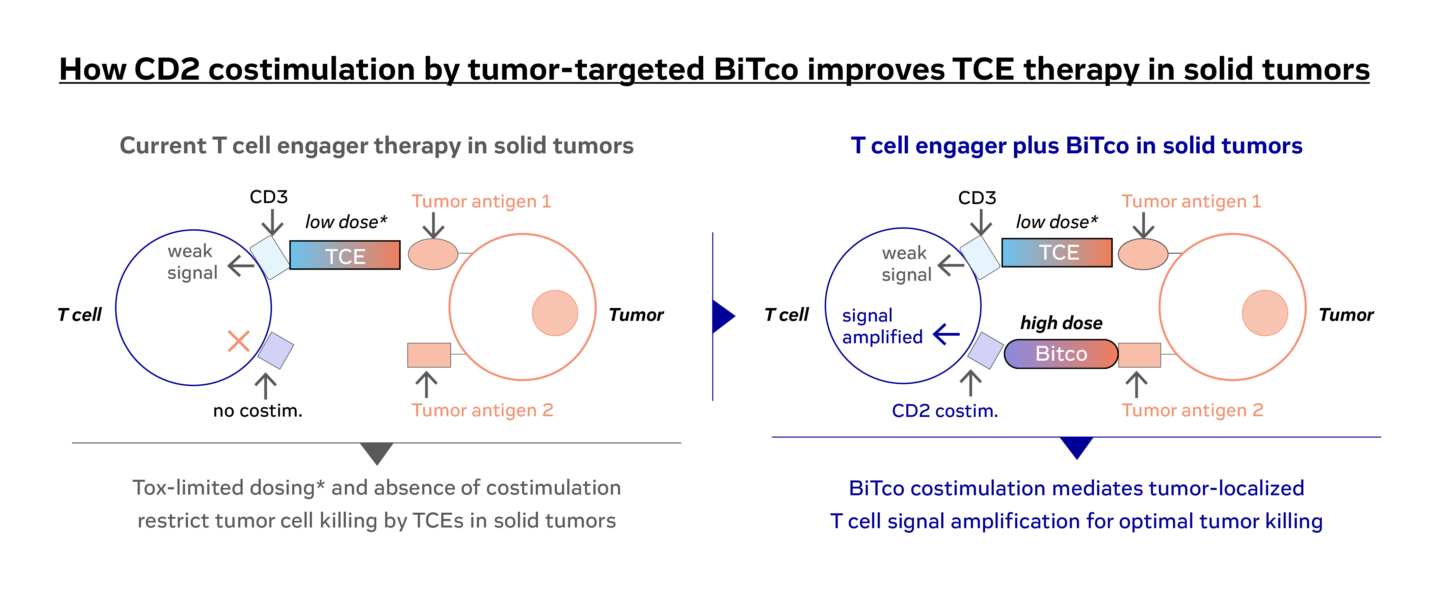
How costimulation by a tumor-targeted CD2 bispecific improves TCE therapy in solid tumors
Key Findings from the Study
Across in vitro experiments, combination treatment with the HER2×CD2 bispecific enhanced TCE-mediated tumor cell killing by approximately ten-fold and increased T cell activation.
The study also demonstrated that CD2 costimulation could rescue anti-tumor cytotoxicity when TCE dosing was intentionally reduced to suboptimal levels. This finding may be relevant in settings where TCE dose intensity is constrained by toxicity or antigen escape.
In vivo findings further strengthened the proof of concept.
In a humanized xenograft model, combination treatment achieved complete tumor remission in eight of nine mice, compared with one of nine animals treated with the TCE alone.
The study also explored immune escape mechanisms that commonly limit immunotherapy responses.
Loss of CD58 expression is a recognized resistance mechanism in TCE therapy because CD58 normally supports productive T cell-target cell engagement. Notably, the HER2×CD2 bispecific enhanced cytotoxic activity even in CD58-deficient tumor cells, suggesting a possible route to overcoming this escape pathway.
Another potentially important observation involved CD28-negative CD8 T cells.
These cytotoxic T cell populations become more prevalent with age and are frequently enriched in solid tumors. While CD28-targeted costimulatory approaches may be less effective in these populations, the CD2-based strategy demonstrated activity in both CD28-positive and CD28-negative T cells.
Finally, the authors reported markedly lower cytokine release relative to a comparator CD28-targeted bispecific while maintaining comparable anti-tumor cytotoxicity - an observation that may have implications for safety and cytokine release syndrome risk.
Why CD2 Costimulation Matters for Solid Tumor Immunotherapy
Although still preclinical, the findings contribute to an important scientific discussion surrounding how T cell engager therapy may be expanded in solid tumors.
A modular combination approach - in which signal 1 and CD2-based signal 2 are delivered independently - could offer several theoretical advantages.
These include:
- Greater dosing flexibility
- Improved therapeutic index
- The ability to use a less tumor-specific tumor target for costimulation
- A potential mechanism to overcome resistance pathways
The ability to restore anti-tumor activity at lower TCE doses may be especially relevant in solid tumors, where toxicity remains a major barrier to efficacy.
At the same time, activation of CD28-negative T-cell populations may broaden applicability in patient populations where these cells predominate.
Translational Considerations and Remaining Questions
Important questions remain.
The findings are preclinical and derived from in vitro systems and humanized xenograft models. Whether these observations translate into clinical benefit remains unknown.
Future research will likely need to address durability of response and performance across different tumor antigen combinations.
Nonetheless, the study introduces an intriguing mechanistic framework for improving TCE function in solid tumors. The inherently low cytokine release by CD2 costimulation suggests that an all-in-one TAA×CD3×CD2 molecule using the CD2 antibody described may still be an additional option.


