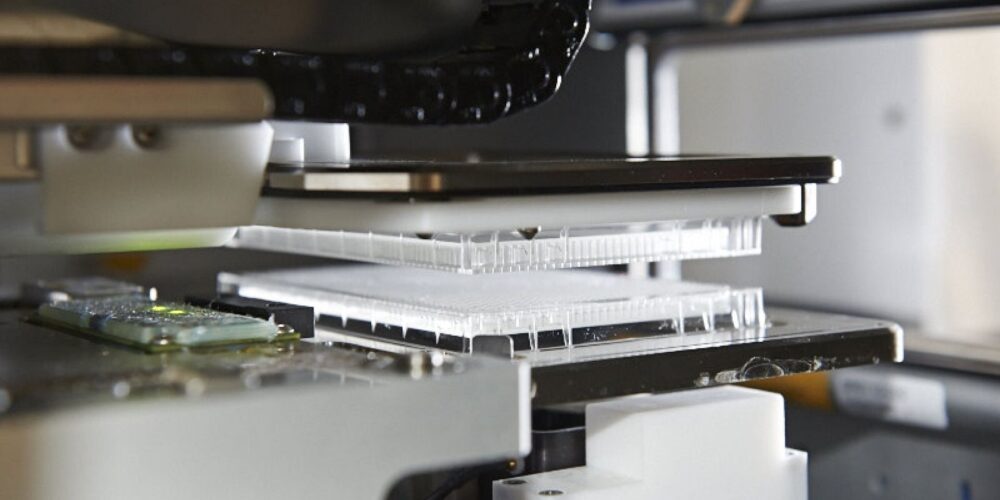
Evotec has been a frontrunner in hit identification services and industry-standard high-throughput screening (HTS) for partners since 1998, resulting in extensive knowledge accumulation over a range of different modalities, target class families, and cellular phenotypic signatures.
Over the past 5 years, Evotec has invested >€12 million in its HTS and hit identification infrastructure to offer an array of state-of-the-art technologies and automated screening platforms, enabling the generation of high-quality hits delivered with lightning speed.
Evotec has been successful in generating tractable hits for historically considered undruggable targets, thanks to our innovations in structural biology, chemistry, and drug design, and other technological advances.
Learn about Hit ID at Evotec
Why choose Evotec as your CRO for hit identification services?
Choose Evotec as your CRO for hit identification because we offer flexible screening options combined with >30 years of drug discovery experience, a team of >150 specialist scientists, and a proven >85% hit generation success rate.
Experience in Hit Identification Services
Established in 1993, Evotec has laboratories in Europe and the USA. The company has gathered vast experience in all areas of lead discovery screening across different therapeutic modalities. In our hit identification and HTS department alone, Evotec has >150 multidisciplinary scientists (30% PhDs) with strong disease area expertise.
In the past 5 years, our scientists have worked on >300 HTS campaigns covering a range of conventional and novel targets, including protein-protein interactions, protein-nucleic acid interactions, and transcription factors, as well as different modalities, such as molecular glues and RNA biology modulators.
Evotec has a proven success rate of >85% in generating validated and tractable hits from HTS campaigns across all target classes (Figure 1).
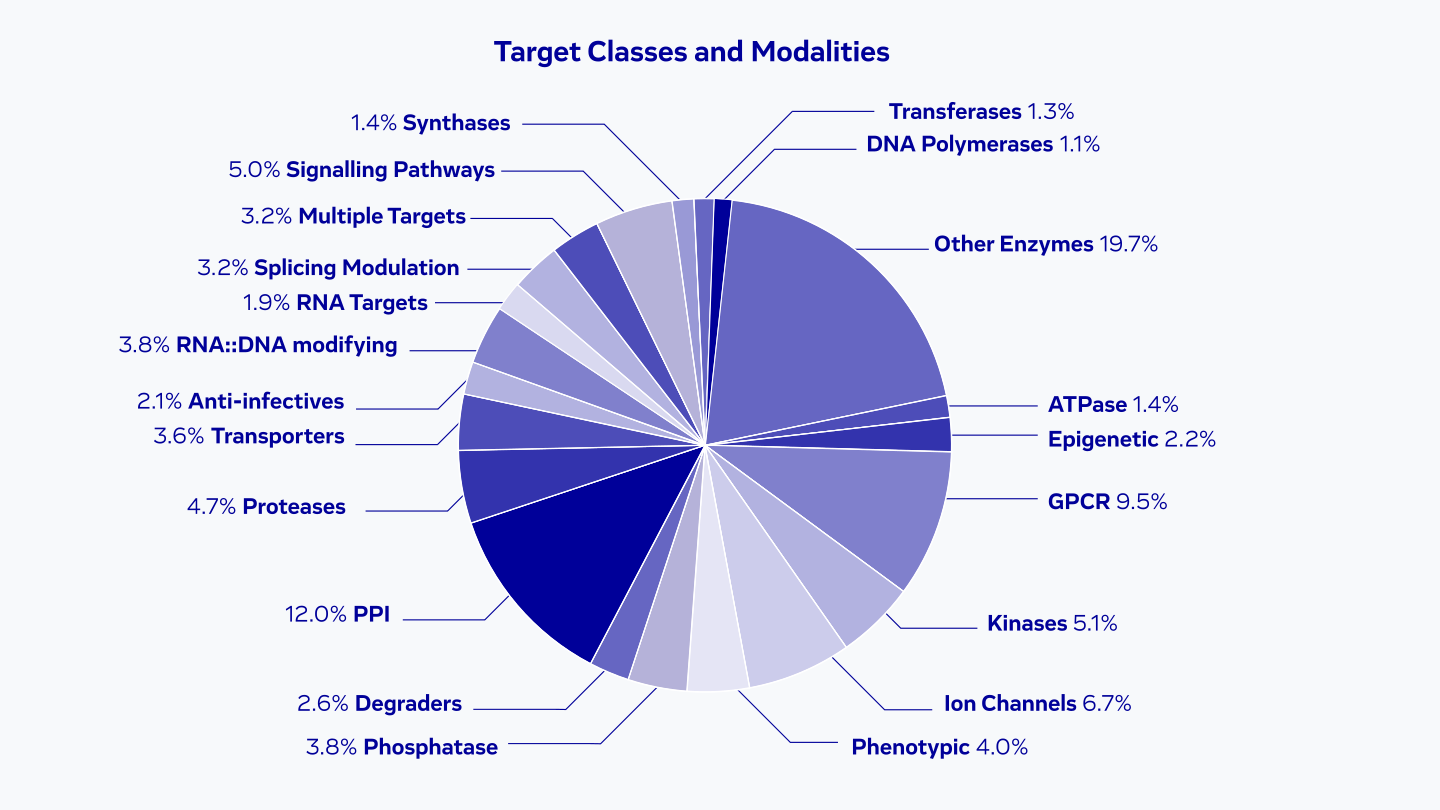
Figure 1. Key target classes and modalities
Compound Collection for Hit Identification Services
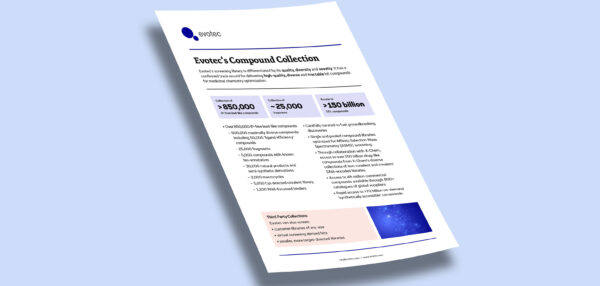
At Evotec, we have a comprehensive and carefully curated library of >850,000 compounds, offering lead-like properties, chemical diversity, and novelty in hit discovery screening. These libraries undergo regular QC testing for purity to guarantee high-quality screening outputs for hit identification.
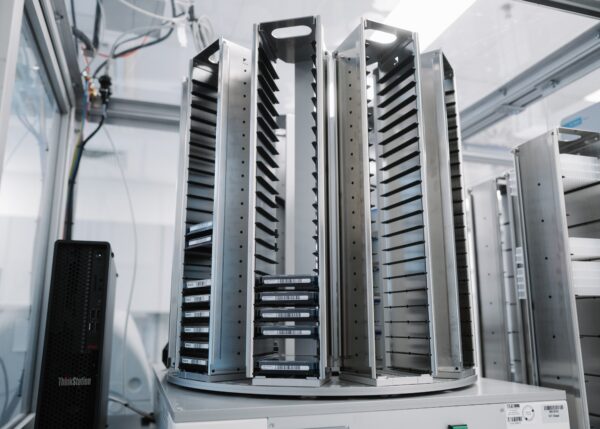
Evotec offers flexible screening strategies for hit identification, including the option to screen your own libraries and/or Evotec’s libraries to give you the best chance of success. Our compound management facility can store and monitor your compounds so you can track compounds in real time through our fully integrated Titian Mosaic software platform.
In addition, through collaboration with X-Chem, Evotec has access to over 150 billion drug-like compounds from X-Chem’s diverse collections of non-covalent and covalent DNA-encoded libraries (DEL).
Platforms and Technologies for Hit Identification Services
Evotec boasts one of the largest and most technologically advanced drug discovery facilities in the world. In the past 5 years alone, >€12 million has been invested in the HTS and hit identification infrastructure.
Our capabilities cover:
- Target-directed screening:
- Phenotypic screening:
- Cell-based screening
- FLIPR services
- Electrophysiology services
- Reporter gene assays
- HiBiT detection
- Immunoassays
- RT-qPCR services
- Flow cytometry and FACS services
- Cellular bioenergetics e.g., Seahorse
- Radiometric assays and autoradiography services
- Metabolomics, proteomics and transcriptomics
- High content screening services
- Cell-based screening
- AI/ML-enabled virtual screening
Flexible Consultative Approach to Hit Identification Services
Evotec offers a flexible and tailored hit identification service with dedicated project managers and full access to scientific experts. Prior to initiation of the screening, a full study plan is created based on the client's project requirements.
From there, our team handles:
- Scientific and technical program assessment
- Operational planning, which determines the optimal screening strategy to ensure project success
- Data review and hit validation, including expert guidance from different disciplines to review and assess data, and advise on hit validation, expansion, and prioritization
Evotec tailors to your needs, offering standalone screening services or supporting fully integrated projects from target validation through to the clinic.
Frequently Asked Questions for Hit Identification
What is hit identification in drug discovery?
Hit identification, also known as hit-finding or hit discovery, is performed at an early phase in drug discovery to identify chemical starting points (known as "hits" or "hit compounds") that show activity against a biological target or cellular phenotype.
The journey of drug discovery starts with a therapeutic premise and rapidly shifts to the need for chemical matter to verify the premise and lay the chemical groundwork for a potential new pharmaceutical.
What are the key approaches used in hit identification?
Target-based screening and phenotypic screening are the two main approaches in hit identification.
Target-based screening measures binding or an effect directly on the known biological target. A range of different target-based approaches exists for hit identification, and these include biochemical, cell-based, and biophysical methods.
Phenotypic screening involves testing molecules in cells, isolated tissues or organs, or animal models to select compounds with a desired biological effect. Phenotypic approaches can shed light on new biological processes and targets.
The use of phenotypic screening often involves evaluating complex disease mechanisms or previously unknown biological targets. Or, it may be used as follow-up, secondary screening approach to prioritize hits from primary target-based screening.
Typically, a combination of both target-based and phenotypic approaches is used in hit identification screening strategies.
What trends are emerging in hit identification?
- Improvement of sophisticated tools:
- Crystallography and computational modeling will continue to improve and further integrate into hit identification workflows. This will not only make an impact in understanding how a novel molecule interacts with its biological target, but also accelerate high-quality lead discovery
- Continually evolving disciplines:
- Molecular biology and genomics will enable an improved mechanistic insight into human disease biology
- Gene editing techniques such as CRISPR have become popular as means for cellular disease modeling, as well as promising therapeutic modalities over recent years
- Complex physiologically relevant phenotypic models:
- iPSCs and organoids that more accurately capture tissue-specific human physiology are increasingly used
- Artificial intelligence and machine learning:
- Both are hot topics in drug discovery and hold great promise in transforming hit identification
As these models continue to improve their predictive capabilities, the speed and ability to find high-quality hits are likely to be significantly enhanced, leading to greater success in hit ID
Learn More
- Read our blog article: How to Optimize your Hit Identification Strategy at Evotec >
- Join our 5-part webinar series on hit identification strategies >